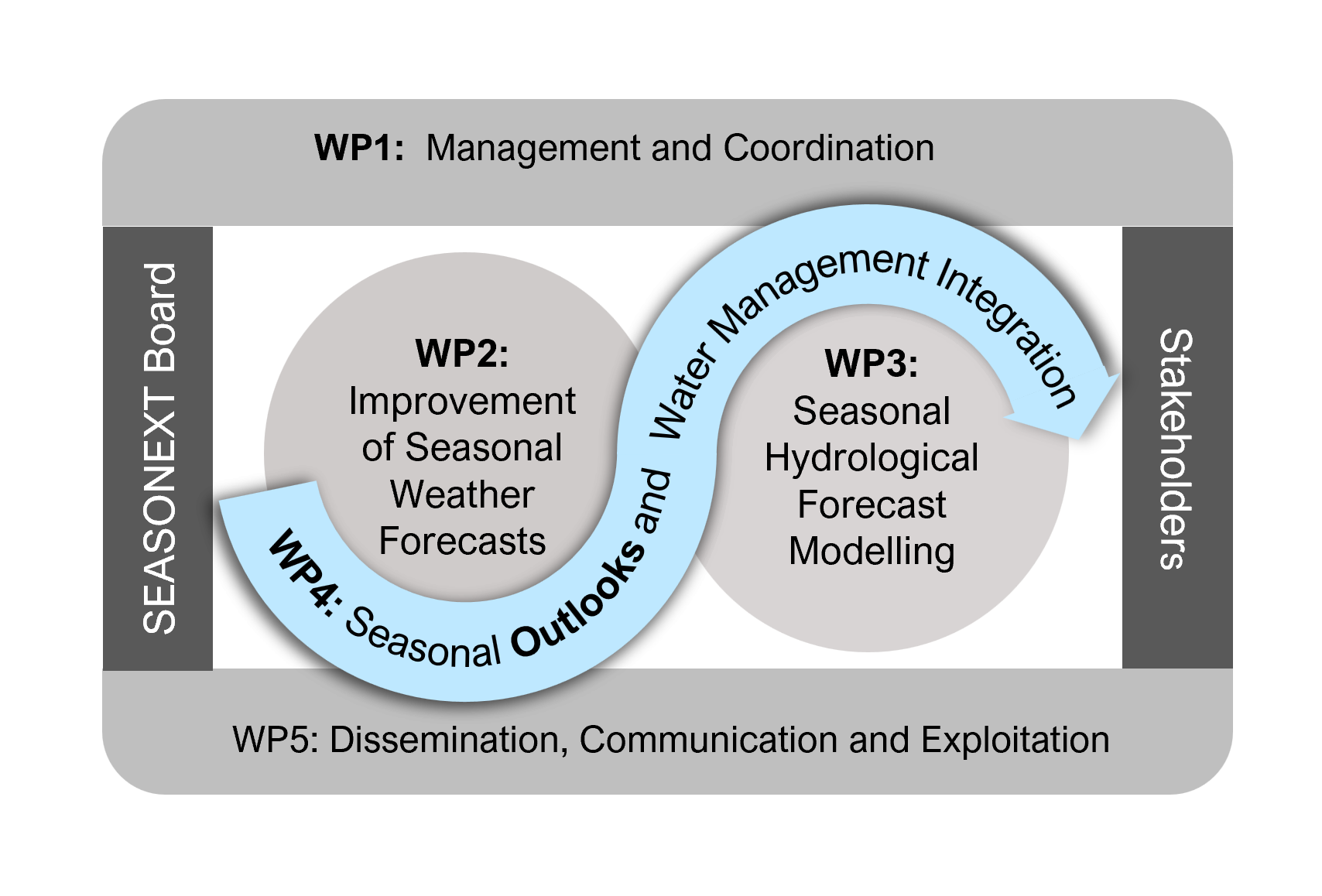
SEASONEXT is structured in five Work Packages (WPs) that form an end-to-end chain from seasonal climate prediction to hydrological outlooks, decision support, and uptake by stakeholders.
Management and Coordination
This WP will create and maintain the conditions to ensure the effective and timely implementation of project goals. To this end, WP1 will work towards facilitating clear and effective flow of information between the research team, managing the scientific coordination between the WPs, and organizing regular Project meetings, physical and virtual. WP1 will also be responsible for ensuring the quality and punctuality of scientific outputs, undertaking the risk management of the project, monitoring the progress of the planned activities, and anticipating as well as addressing potential issues. In addition, robust data management and ethical procedures will be developed and implemented under this WP. Finally, WP1 will manage communication and reporting to HFRI.
Improvement of Seasonal Climate Forecasts
WP2 will generate enhanced seasonal climate forecasts in Greece by integrating and processing a variety of climatic data. This involves a detailed evaluation of multiple precipitation datasets to identify reference datasets for bias adjustment. Historical atmospheric data and a tailored assessment tool, we will define Weather Regimes, their teleconnections, and their impact on local weather, particularly precipitation and temperature. The focus will be on assessing the seasonal forecast skill of C3S prediction systems in replicating these WRs and teleconnections. The reference observational dataset and the identified WRs will serve as the basis for enhancing the accuracy of local-scale climate forecasts. This involves using advanced machine learning algorithms produce a fully bias-corrected and downscaled seasonal forecast over the Greek domain. This information will support the development of seasonal hydrological forecasts.
Development of a Robust Hydrological Model for Crete
This WP will be responsible for the development of a robust hydrological model that will facilitate the transformation of seasonal climate forecasts into hydrological projections. Activities include the collection of detailed hydro-meteorological and physiographic data for model configuration. This includes acquiring streamflow data, land use patterns, and soil characteristics, utilizing resources like the CORINE Land Cover inventory and the European Soil Data Centre. The open-source HYPE model will be calibrated based on the specificities of the Crete pilot area and validated against streamflow records. For ungauged basins, a tailored regionalization scheme will be applied to approximate the model parametrization. The validated HYPE model will be then driven by the enhanced seasonal climate hindcasts from WP2 to provide seasonal projections. As a next step, WP3 will explore the seasonal predictability of streamflow extremes. Predictive capacity will be assessed utilizing methodologies such as the Brier Score and further conducting impact-based evaluations against historical events. This phase aims to link the predictability of seasonal flows to specific hydrological processes, thereby deepening the understanding of catchment memory regimes and their influence on streamflow patterns.
Seasonal Outlooks and Water Management Integration
This WP aims to synthesize data and modelling outputs from previous work packages to develop robust, user-friendly tools for improving the resilience of water systems. The primary objectives are to transform complex scientific data into practical, actionable insights for a wide range of stakeholders and to tailor the Seasonal Outlooks Prototype Platform and Water Resource Management (WRM) Decision Analytic Framework to the specific needs of Crete through active engagement with local water authorities and stakeholders. This involves organizing stakeholder workshops and user surveys to integrate local knowledge, validating, and adapting scientific analysis to local conditions, identifying user needs and management bodies, selecting pilot sites for applying the WRM Framework, and testing prototype tools. Additionally, it focuses on the development of the Seasonal Outlooks Platform, leveraging cloud computing for scalable, reliable data processing and storage, and the creation of the WRM Decision Analytic Framework, which simulates impacts of sustainable management practices and generates solutions for resilient water management under various scenarios.
Dissemination, Communication and Exploitation
This WP is devoted to awareness raising, exploitation of results and project outreach. Envisioned outputs are i) a project communication and dissemination plan, ii) a project exploitation roadmap, and iii) a series of targeted and general project outreach campaigns and materials. Various means of dissemination will be used including standard means such as a project website, social media channels, scientific publications, and conference presentations, press releases as needed, and a policy brief. A final SEASONEXT dissemination event will be planned in which academics and policymakers and other stakeholders will be informed on project’s innovations and provide feedback and recommendations for further research and activities and upscaling. WP5 will also be responsible of ensuring the further exploitation of project outcomes after the lifetime of SEASONEXT. For this, the exploitation roadmap will: 1) prioritize SEASONEXT outcomes with the highest exploitation potential; 2) identify and rank the next target water districts; and 3) blueprint the potential market penetration for a climate service.